Disclaimer
Products supplied by SYNA Labs Ltd are intended strictly for laboratory and scientific research purposes only. They are not medicines, are not approved for human or veterinary use, and must not be used to diagnose, treat, cure, or prevent any disease or medical condition. Products are not for human or animal consumption, cosmetic, food, or recreational use. By purchasing from SYNA Labs Ltd, customers confirm they are qualified individuals or entities purchasing solely for legitimate research purposes and agree to our Terms and Conditions and Research Use Policy.
Tesamorelin is a synthetic analogue of growth hormone-releasing hormone (GHRH), developed for laboratory research into neuroendocrine signalling, receptor-mediated pathways, and peptide biology more broadly. As a modified GHRH analogue, it gives researchers a reliable molecular tool for studying growth hormone regulatory mechanisms under controlled experimental conditions.
In laboratory settings, Tesamorelin is frequently used to examine GHRH receptor activation, intracellular signalling cascades, cyclic AMP (cAMP) responses, and downstream transcriptional effects in relevant cellular models. It also supports research into peptide stability, receptor affinity, and signalling selectivity across a range of biochemical and cell-based assays, with results varying according to concentration, exposure duration, assay design, and the model system used.
Product: Tesamorelin
Synonyms / Designations: Tesamorelin, TH9507, Growth Hormone-Releasing Hormone (GHRH) Analogue
CAS Number: 901758-09-6
Molecular Formula: C₂₂₁H₃₆₆N₇₂O₆₇S
Molecular Weight: 5135.91 g/mol
Peptide Type: Synthetic GHRH Analogue
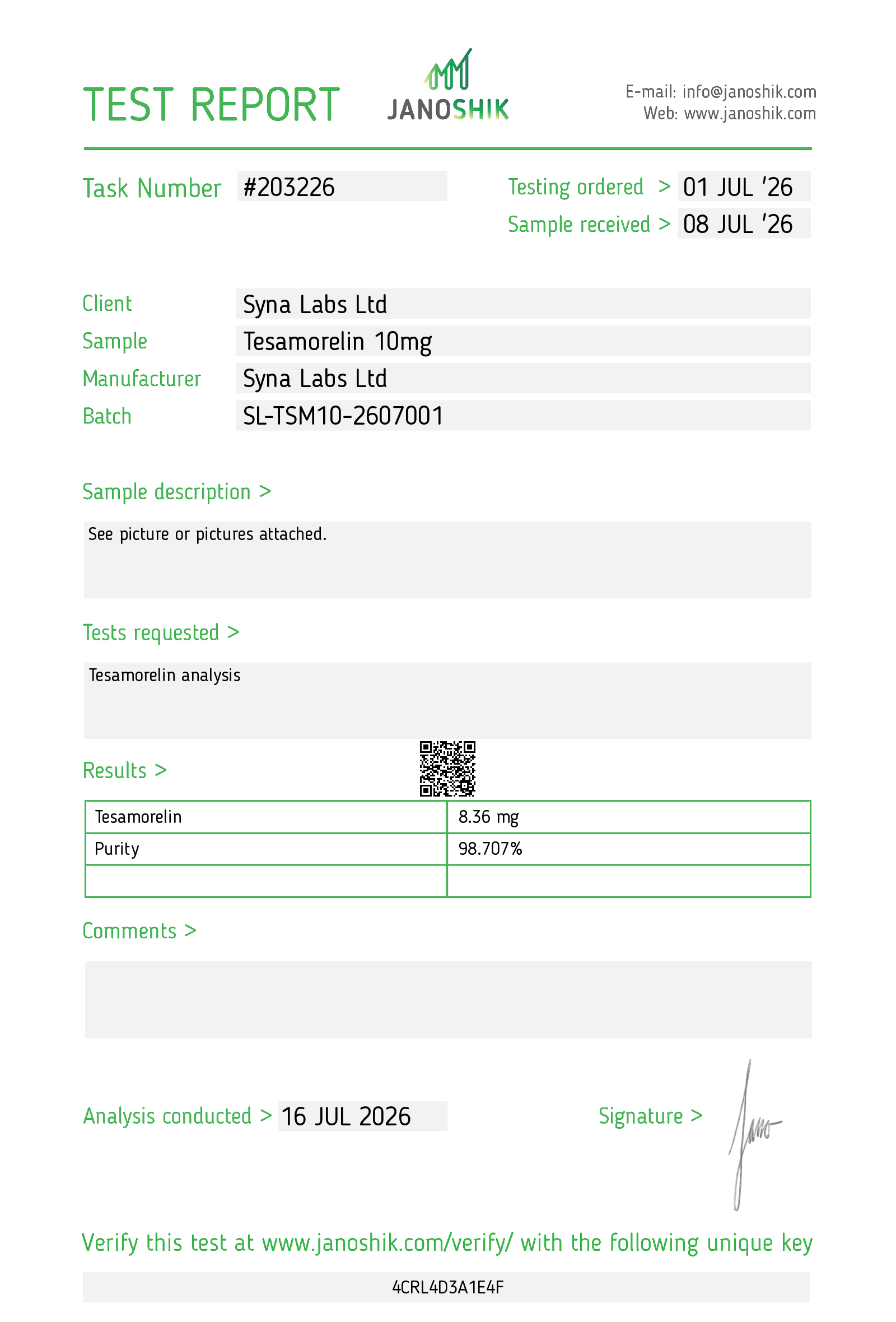
Purity: ≥99% (HPLC)
Appearance: White to off-white lyophilised powder
Pack Size: 5 mg
Storage: Desiccated, protected from light, stored at –20°C or below
Solubility: Freely soluble in water and aqueous buffer systems.
Applications in Research
- Investigation of GHRH receptor activation and signalling pathways.
- Studies of growth hormone regulatory mechanisms in pituitary-derived cell models.
- Evaluation of peptide stability, receptor affinity, and signalling selectivity.
- Research involving neuroendocrine signalling and intracellular communication.
- Analysis of cAMP-mediated responses and downstream molecular effects.
- Use as a reference compound in peptide and endocrine research.
Specifications Summary
| Parameter | Typical Value / Range |
| Purity (HPLC) | ≥99% |
| Peptide Type | Synthetic GHRH Analogue |
| Molecular Formula | C₂₂₁H₃₆₆N₇₂O₆₇S |
| Molecular Weight | 5135.91 g/mol |
| Appearance | White to off-white lyophilised powder |
| Solubility | Freely soluble in water and aqueous buffers |
| Storage | –20 °C, desiccated, dark |
| Pack Size | 10mg / 20mg |
Handling, Reconstitution & Stability
- Handle under dry conditions to minimise moisture exposure.
- Reconstitute using sterile water or an appropriate aqueous buffer according to experimental requirements.
- Avoid vigorous agitation during dissolution.
- Prepare fresh solutions where possible for optimal stability.
- Aliquot reconstituted solutions prior to storage and protect from prolonged light exposure.
- Store reconstituted solutions at –20 °C (or lower) to avoid repeated freeze–thaw.
Precautions & Notes
- Experimental performance may vary depending on concentration, pH, temperature, and assay conditions; appropriate controls should be used when conducting receptor-mediated or signalling studies.
- Tesamorelin is sensitive to degradation under unsuitable storage conditions.
- Buffer composition and ionic strength may influence stability and activity in certain applications.
- Protect from excessive heat, moisture, and prolonged light exposure.
- Tesamorelin is intended exclusively for laboratory research and analytical applications. For research use only — not for human consumption, therapeutic use, diagnostic procedures, performance enhancement, or veterinary applications.